Rugby asks more of a mouthguard than most sports do. You wear it through scrums that push for seconds at a time, rucks where boots and knees are moving around your head, and tackles you sometimes don't see coming. And you still have to breathe and call lineouts through it for eighty minutes. This guide covers what the rules say at each level, what the game does to a guard, how to choose one, and how to look after it.
The short answer
Yes, wear one for all contact rugby. World Rugby recommends a mouthguard for all players, and some unions, such as Rugby Ontario, make it mandatory. Get one that covers your whole upper arch, stays on without clenching, and lets you breathe and talk. A fitted boil-and-bite is the minimum. A custom guard made from your own impression fits best.
Rugby mouthguard rules by level
Rugby's rules are layered. World Rugby sets the laws of the game, and national, state and provincial unions can add their own requirements on top. Leagues and schools can add more. Whatever your level, the rule that applies to you is the strictest one in that chain.
World Rugby
Law 4.2 of the Laws of the Game reads: "World Rugby recommends all players wear a mouthguard or dental protector." So at the world level it's advice. The same law lists a mouthguard among the items players may wear, and all clothing has to comply with World Rugby Regulation 12. Unions can and do go further.
USA Rugby
The most recent USA Rugby equipment document we could find, its Protective Equipment and Clothing Guidelines 2019/20, says mouthguards "should be worn by every player, every time they play contact rugby." It also says a guard should not have pieces sticking out of the mouth, such as a football-helmet strap, and that the guidance applies to sevens, tens, fifteens and beach rugby at every age. We could not find a current national USA Rugby rule that makes mouthguards mandatory. State unions, high school associations, clubs and tournaments often set their own equipment rules, so check with yours. US high school rugby generally sits outside the NFHS rulebook, but the NFHS Sports Medicine Advisory Committee recommends mouthguards for any sport with a risk of mouth and facial injury, and rugby clearly qualifies.
Rugby Canada and the provinces
We could not find a national Rugby Canada rule that requires mouthguards. In Canada, the clearest rules come from the provinces. Rugby Ontario's Mouthguard Use Policy, in effect from April 28, 2026, makes mouthguards mandatory "in all matches, training sessions, and warm-ups involving contact." Its motto is "No mouthguard, no contact," and coaches and officials check before contact starts. If you play in another province, ask your provincial union or club what its current policy is.
Youth rugby
Youth policies are usually stricter than adult ones. The Rugby Ontario policy above covers its youth players, and it gives parents a job: make sure your child has a properly fitted guard and always wears it for contact rugby. If your child plays elsewhere, ask the coach or check the club's registration pack for the local rule.
Smart mouthguards in elite rugby
At the top of the sport you'll see instrumented mouthguards, or iMGs. World Rugby defines them as "mouthguards that have embedded sensors to measure linear and angular kinematics of the head". Its specification, dated November 2023, requires CE certification for impact energy absorption plus accuracy targets in lab and on-field testing. In competitions that use the Head Injury Assessment (HIA) process, the device also has to report head-acceleration data from each half within five minutes of that half ending.
A World Rugby update from March 2024 says players "will continue to wear the iMGs in all competitions using the premium Head Injury Assessment protocols." When a player's guard triggers an alert, a doctor checks them on the field, and if there is any concern the player leaves for an HIA. The technology flags big head impacts so medical staff can assess a player sooner. It does not stop a concussion from happening. Rugby Ontario says it plainly in its policy: "Wearing a mouthguard does not prevent concussion." The NFHS committee also says the research does not support mouthguards reducing concussion. For club and youth players, iMGs are not part of the picture. What you need is an ordinary mouthguard that fits.
What rugby asks of a mouthguard
Rugby contact comes in two kinds, and a guard has to cope with both. The first is structured and repeated. In a scrum or a maul, a forward's head and jaw take sustained compression rather than one sharp hit, over and over across a match. A guard that only holds when you bite down will slowly work loose under that kind of load. What you want is one that stays seated under pressure, scrum after scrum.
The second kind is open play: a shoulder in the tackle, a knee at the breakdown, a boot in a ruck. These arrive with little or no warning, and nobody braces for them the way a prop braces for the engagement. You can't clench for a hit you didn't see, so the guard has to already be in place and doing its job. If you're reseating your guard with your tongue fifteen minutes into the half, it won't be fully seated when the unexpected hit lands.
Then there's communication. Hookers call lineouts, nines direct the pack, and everyone talks in defense. A guard that is too bulky, or that has to be held in with your jaw, makes all of that harder, and players who can't talk in their guard tend to take it out. A guard sitting in your sock doesn't protect anything.
Choosing a rugby mouthguard
Fit and coverage
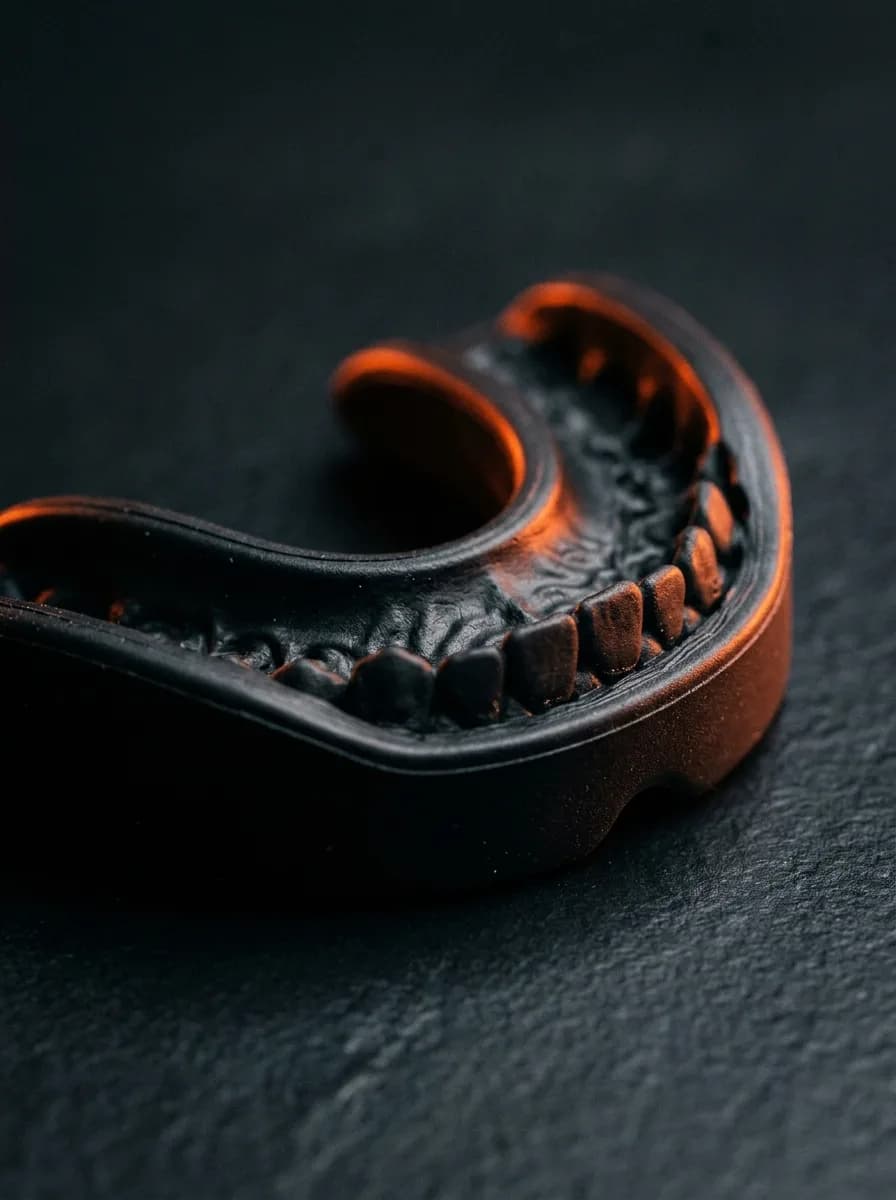
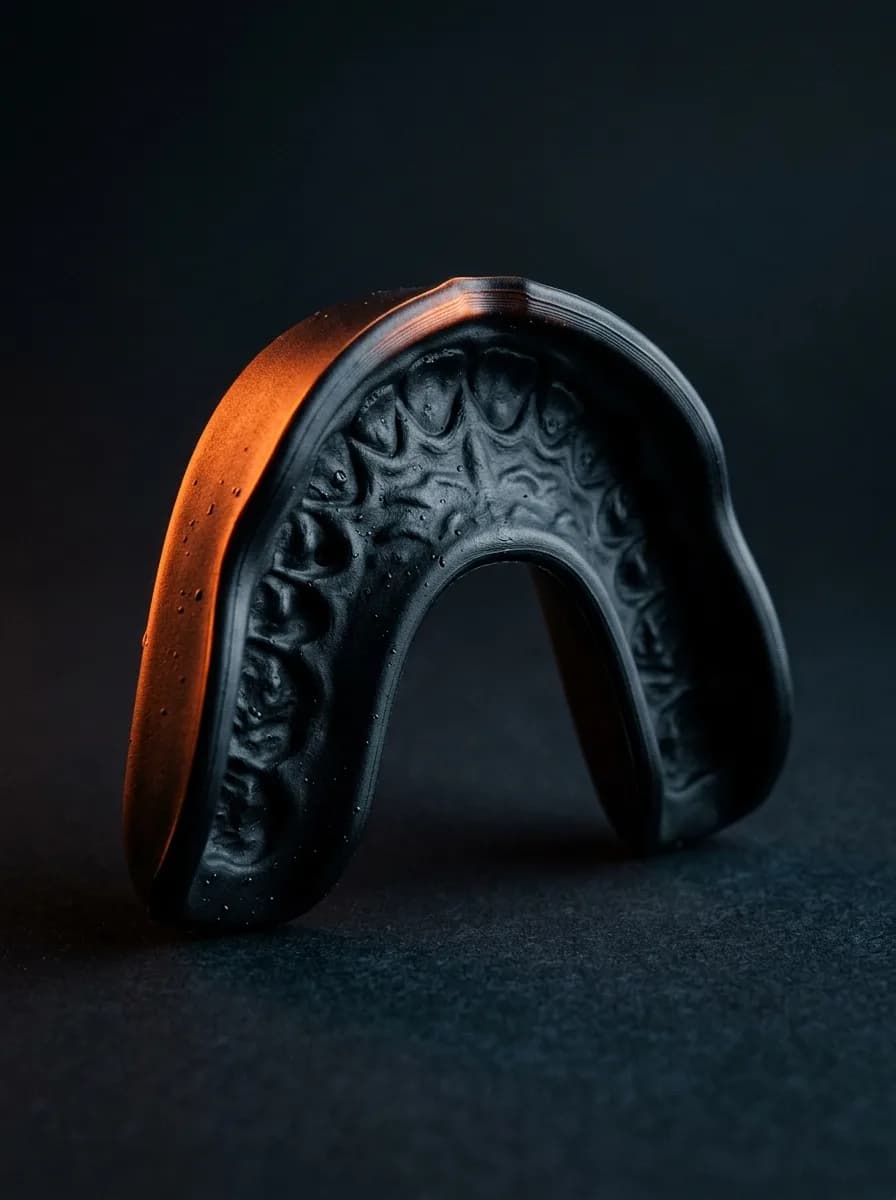
Most rugby players need a guard on the upper teeth, which take the brunt of impact according to the American Dental Association. It should cover the full upper arch back to the last molar, stay on without you biting down, and not rock when you push it with your tongue. Our guide on how to fit a mouthguard walks through four quick checks. If your guard keeps dropping, see why a mouthguard keeps falling out. If your lower teeth sit in front of your upper teeth (an underbite), talk to your dentist before buying, because that bite may need a different setup.
Thickness
The American College of Prosthodontists says "standard thickness is 4 mm for most contact sports," with 5 to 6 mm suggested for extreme sports. Lab work points the same way: Westerman and colleagues found the best EVA thickness was around 4 mm, with smaller gains above that. Thicker is not automatically better. Past a point you trade comfort, breathing and speech for very little extra protection, which matters in a sport where you talk all game.
Breathing and talking on the line
Bulk at the front and a palate covered further back than it needs to be both make breathing and talking harder. A thinner, closer fit leaves more room for air and for your tongue to form words. That helps when you're blowing hard after a long phase or calling a lineout code over crowd noise. There's more on this in how to breathe with a mouthguard in.
Boil-and-bite vs custom for rugby
Rugby Ontario's policy is a useful summary of how the sport sees the options. It strongly recommends custom dentist-fitted guards, allows properly fitted boil-and-bite guards, and does not allow stock (unfitted) or damaged ones. Between the two allowed options, you're choosing how good a fit you want and what you'll pay for it.
A boil-and-bite can give a passable fit if you mold it carefully. The weak point is the home molding itself. Pressing warm plastic by hand tends to leave it thicker in some spots and thinner in others, and the material loosens with wear. Rugby finds that out fast, because scrums and rucks keep pressing on the guard all match.
A custom guard starts from a model of your teeth. The NFHS committee says proper fit is ensured by a guard "constructed from a model made from an impression of the individual's teeth." Thickness and coverage are set when the guard is made, so they don't depend on how hard you bit down in the kitchen. Dentist-made custom guards commonly cost around $300 to $500 or more. For a full side-by-side, read boil-and-bite vs custom mouthguard, and the complete custom mouthguard guide covers materials, cost and the impression process in more depth.
Youth players and braces
Kids' mouths change quickly. The ADA notes that children and teens may need to replace mouthguards more often because their mouths are still growing. For a player still losing baby teeth (roughly under 12), a custom guard will need refitting or replacing as adult teeth come in. A good boil-and-bite is a reasonable stopgap until growth slows, and it's worth checking with their dentist. Older youth players may still need a new guard more often than adults, and any time the fit changes.
Braces are a separate issue. A standard at-home impression kit can't make a braces-compatible guard, because the putty can't release cleanly around brackets and wires. A braces fit needs a professional digital scan taken in person by a dentist. If your player is in braces, contact GumGear before ordering so we can confirm it suits their treatment, and ask their orthodontist what they recommend.
Care and replacement
Rugby Ontario's policy includes simple care rules: rinse before and after use, store the guard in a ventilated case, keep it away from heat such as car dashboards and hot water, and replace it annually or sooner if the fit changes. Mud, grass and long bus rides make the case more important in rugby than in most sports. Clean it properly after every session; our guide on how to clean a mouthguard has the details. Check it for bite-throughs, tears or a looser fit, especially if you play forward, and see how long a mouthguard lasts for the signs that mean replace it now.
If you also play hockey or lacrosse
Plenty of rugby players have a second sport, and hockey and lacrosse have their own mouthguard rules. We cover those in hockey mouthguard rules and lacrosse mouthguard rules. One well-fitted guard can often do the job across contact sports, but check each sport's rules for color, strap and attachment requirements.
Where GumGear fits
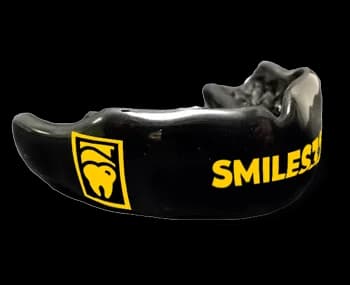
GumGear's Contact Guard is our Sport Guard tier for rugby. It costs $99, has a 4 mm front-tooth thickness in dual-density EVA, and is pressure-laminated in multiple layers at our facility in Rochester, Minnesota. It's built from an impression of your own teeth, so it matches the NFHS description of a properly fitted guard without a dentist visit. We mail you a kit, you take the impression at home and send it back. You can also upload a digital scan (.stl) from any dentist at checkout. We ship to the US and Canada. Standard US delivery is 10–14 days, and Canadian orders can take longer. Every guard comes with a 30-day fit guarantee. You can design the colors and artwork in our 3D customizer, and teams can order together with a minimum of 10 units. A parent or guardian places the order for players under 18. See the full build on the Contact Guard page.