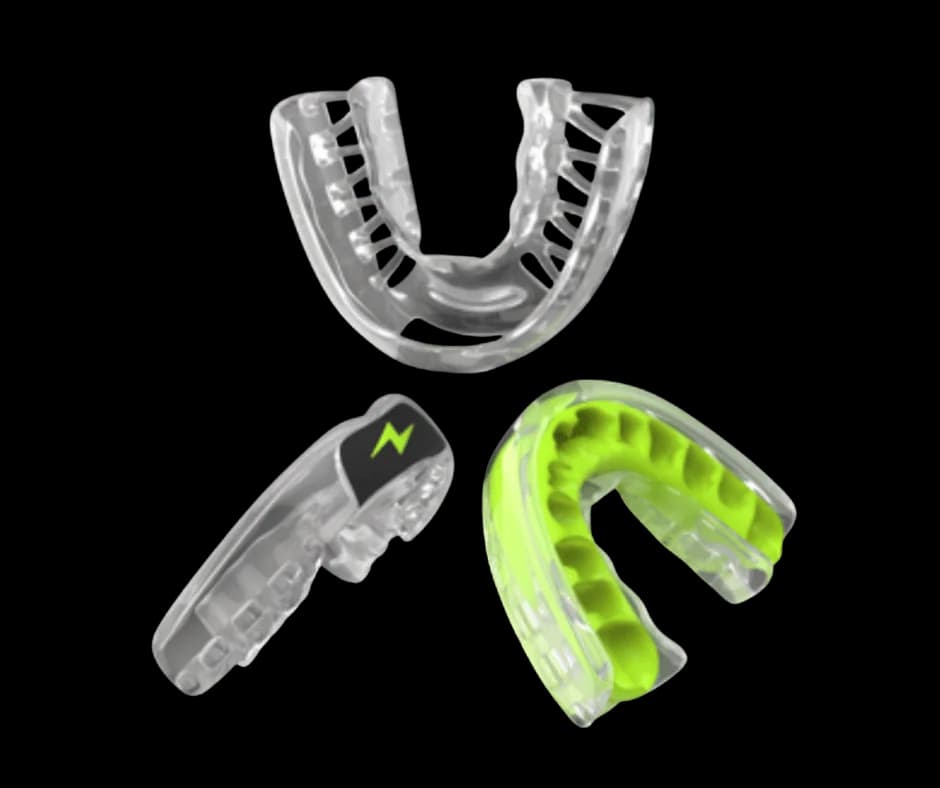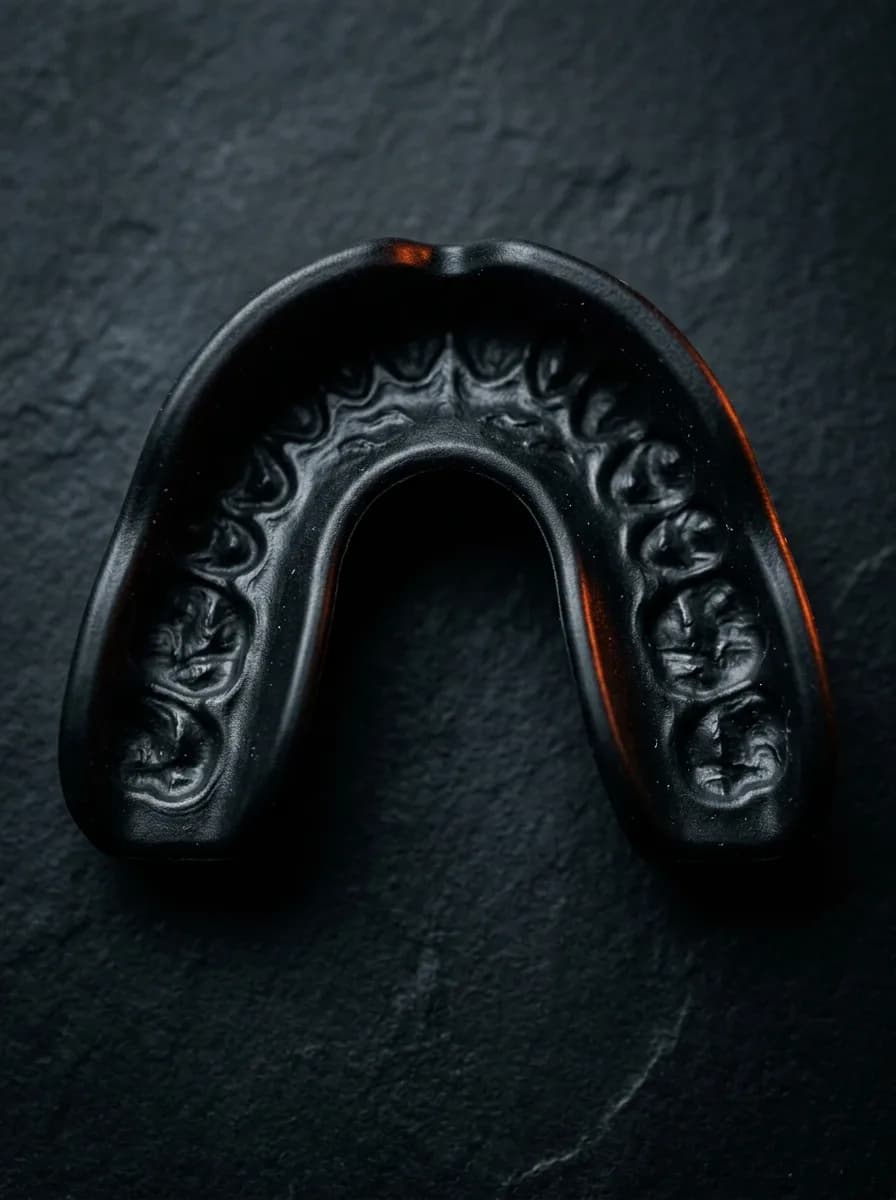
A custom mouthguard is moulded from your own dental impression — the same basic method a dentist uses, run as a direct-to-consumer flow you can complete from home. This guide covers what a first-time buyer needs to know: what makes a custom guard different, who it is worth it for, sport-by-sport requirements, materials, how it compares with the alternatives, what the ordering process looks like, and the mistakes that waste money.
What is a custom mouthguard?
A custom mouthguard is a protective oral appliance moulded to the exact shape of your teeth, gums, and bite. It is made by taking a dental impression — either at a clinic or at home using a kit like GumGear's — and pressure-laminating multi-layer medical-grade EVA over a positive cast of that impression. The result is a guard that fits one set of teeth: yours.
That is fundamentally different from a boil-and-bite, which starts as a generic plastic shell and softens enough to approximate your bite. It is also different from a 3D-printed appliance, which can match your geometry but does not currently match the impact properties of pressure-laminated EVA.
One more distinction worth making early: "custom" here means custom to your teeth, not just custom in colour. Printing your name on a generic shell does not change how it fits. The thing that makes the product different is the order of operations — your teeth are captured first, and the guard is built to that shape, rather than a blank being pressed against your teeth afterwards.
How a mouthguard protects you
A mouthguard does three jobs, and it helps to know them because they explain almost every buying decision that follows.
- It spreads load. Without a guard, a blow to the face concentrates force on whichever teeth take the hit. A guard that covers the whole arch distributes that force across many teeth and the surrounding bone instead of a few.
- It absorbs energy. The EVA layers compress and dissipate part of the impact before it reaches enamel, and they also cushion the soft tissue of your lips and cheeks, which would otherwise be pressed against sharp tooth edges.
- It steadies the lower jaw. A guard sits between the upper and lower teeth, so when the jaw is knocked shut the teeth meet the material rather than each other.
What a mouthguard does not do is make you injury-proof. It reduces the risk of dental and mouth injuries; it does not eliminate it, and we do not claim it prevents concussion. Treat it as one piece of protective equipment alongside technique, supervision, and whatever other gear your sport requires.
Why fit is the whole game
All three of those mechanisms depend on the guard staying in place during contact. When a guard shifts, the load concentrates on a few teeth instead of dozens. That is where chipped incisors, cracked molars, and root fractures come from — even in athletes who were wearing a mouthguard. Retention under load is the single property that separates a good guard from a decorative one.
Fit also affects everything you notice day to day. A guard that covers the arch evenly is easier to breathe around and talk through. A guard with uneven thickness or a bulky rear edge can make your jaw work harder than it should, which is covered in mouthguard jaw pain: causes and fixes. And the practical test for whether any guard fits properly — four checks you can run in under a minute — is laid out in how to fit a mouthguard.
Who actually needs a custom guard
Not everyone does, and it is worth being straight about that. A useful way to decide is to ask four questions.
- How often do you take contact? Weekly or more in a combat or contact sport is where retention under repeated load starts to matter. One casual game a month is a different situation.
- What is at stake in your mouth? Crowns, veneers, implants, bridges, and large fillings are expensive and sometimes difficult to replace. If you have any, a guard that stays put is protecting more than natural enamel.
- Do you need to talk or breathe hard while wearing it? Coaches, referees, and anyone doing high-output rounds notice a bulky or shifting guard quickly.
- Will your teeth change soon? If you are a still-growing teenager or about to start orthodontic treatment, the fit of any guard has a short shelf life. That is covered under special cases below.
If you answered "often," "yes, I have dental work," or "yes, I need to perform in it," custom is the right tool. If every answer points the other way, a generic guard is a reasonable choice and spending more is optional.
Custom vs boil-and-bite
Boil-and-bite guards are inexpensive — generic market prices run roughly $15–$40, depending on brand and retailer — and are appropriate for casual recreational play. They tend to loosen within weeks to a few months of regular use, can capture the molars unevenly, and many athletes find them hard to breathe and speak around during high-output rounds. Once you are training in a contact or combat sport more than once a week, a boil-and-bite is usually not the right tool.
Full comparison with protection mechanics, fit retention, and per-year cost in boil-and-bite vs custom mouthguard.
Custom direct vs dentist-made
A dentist-made sports guard is the other route to a custom fit. The dentist takes an impression in the office, a lab fabricates the guard, and you return for fitting. The manufacturing methodology is the same family as a direct-to-consumer custom flow: impression → cast → pressure-lamination → trim. What differs is the logistics and the price. A dentist-made guard generally costs more than a direct custom guard because it includes chair time and clinic overhead, and it usually involves more than one visit and a longer wait.
Direct-to-consumer flows like GumGear use the same impression concept — done at home in 5–10 minutes — and a pressure-lamination sequence at our own facility in Rochester, Minnesota, priced at $99–$169. If you have a dentist you trust and already have an appointment booked, a dentist-made guard is a perfectly good option, and it is the better route if you need something a home kit cannot provide, such as a braces-compatible fit. For the full side-by-side across all three options, see are custom mouthguards worth it?
The three options side by side
| Feature | Boil-and-bite | GumGear custom | Dentist-made |
|---|---|---|---|
| Price | Roughly $15–$40 (generic market range) | $99 Contact · $169 Combat | Typically the highest of the three; varies by practice |
| Fit method | Generic shell softened and bitten by hand | Your impression, laminated over a cast | In-office impression, lab-laminated |
| Effort | Immediate, one attempt at a time | Home impression, then 10–14 days to your door | Appointments plus lab wait |
| Braces | Does not seat predictably over brackets | Not possible with the at-home kit | Possible with a professional scan |
| Best for | Occasional play, kids still growing | Regular contact and combat training | Complex cases, braces, clinical guidance |
Choosing by sport
Different sports stress a guard differently. The two-tier structure GumGear sells under Sport Guard is built around this distinction:
- Contact Guard ($99): rugby, hockey, lacrosse, basketball, BJJ. Lighter multi-layer construction tuned for tackles, sticks, falls, clinch positions — not for repeated direct strikes.
- Combat Guard ($169): MMA, boxing, Muay Thai, kickboxing. Heavier multi-layer construction with more thickness over the front incisors and molars where strike force concentrates.
If you play a mix, pick for the harder-hitting activity. A Contact Guard worn for sparring is under-built for the job; a Combat Guard worn for a weekend five-a-side game is more guard than you need but will not hurt you. For the combat-sport deep dive — what coaches look for, why double guards rarely work in practice, fight-week protocols — start with mouthguards for combat sports. For MMA specifically: best mouthguard for MMA. Field and ice sports get their own treatment in mouthguards for rugby, hockey and lacrosse.
Two products sit outside the sport guard category entirely. The Scuba Guard ($199) is a custom regulator mouthpiece built to reduce bite fatigue on long dives, covered in the custom scuba mouthpiece guide. The Party Guard ($99) is a decorative, removable guard for nights out; it is a statement piece, not protective sports equipment.
Materials and durability
Athletic mouthguards are made of EVA — ethylene-vinyl acetate, a thermoplastic copolymer chosen for its energy-absorption properties and its compatibility with multi-layer pressure-lamination. GumGear uses BPA-free, latex-free, medical-grade EVA. The same family of material is used by dental labs worldwide.
Durability is governed by three things: bite force exposure, heat exposure, and cleaning method. Avoid all hot water (dishwasher, sterilisation cycles, hot car interiors) and avoid alcohol-based mouthwash as a cleaning agent — both accelerate EVA breakdown. Full routine in mouthguard care, cleaning & replacement.
How ordering a GumGear guard works
The whole flow takes 10–14 days end-to-end for standard orders:
- Order online and design your guard in the 3D customiser.
- Receive an impression kit by mail.
- Take the impression at home — step-by-step guide.
- Ship it back in the prepaid envelope.
- GumGear fabricates and QCs your guard in-house (the lab stage is 2–3 business days). Full manufacturing breakdown: how custom mouthguards are made.
- Tracked-courier delivery to your door.
If the finished guard does not fit when it arrives, you have 30 days to get in touch, and we will work with you on a remake at no charge if one is needed.
Getting a good impression
The impression is the one step that is in your hands, and everything downstream is built from it. A few habits make the difference between a clean impression and one that has to be retaken.
- Read the instruction card before you open the putty. Working time is short once the material is mixed, so the sequence needs to be familiar before you start.
- Seat the tray fully and hold still. Movement while the material sets is the most common cause of a blurred or distorted impression.
- Check the result before you ship it. Every tooth should be visible, including the back molars, with the gum line captured and no bubbles, voids, or smudging.
- Do it in a calm window. Not rushed, not right after a meal, and with someone to help if you want a second pair of hands.
The full walk-through, including the mistakes to avoid, is in how to take a dental impression at home.
What a good fit feels like
When the guard arrives, try it before you train in it. A well-fitting custom guard should snap onto your upper teeth and stay there with your jaw relaxed, cover every tooth back to the last molar with an even edge, leave your gag reflex alone, and not rock when you press on it from the side. Those are the same four checks that apply to any guard, set out in how to fit a mouthguard.
Expect a short adjustment period. A new guard feels like a foreign object for a session or two, and mild awareness of it is normal. What is not normal is a sore spot, a guard that drops when you relax, or jaw aching that keeps coming back. If that happens inside your first 30 days, contact us rather than adjusting it yourself. If pain persists or gets worse, see a dentist rather than troubleshooting the guard.
Braces, kids and special cases
Braces. The at-home kit cannot make a braces-compatible guard. The impression putty cannot release cleanly from around orthodontic brackets without distorting, so a braces-compatible fit needs an in-person professional scan. If you are in braces, get in touch with us before you buy rather than relying on a home impression.
Growing teeth. Children and teenagers whose teeth and jaws are still changing outgrow the fit of any guard quickly. For them a generic guard replaced as they grow is often the practical choice until things settle down; a custom guard makes most sense once growth has slowed.
Existing dental problems. A guard is not a treatment. If you have gum disease, loose teeth, a recent extraction, or ongoing jaw pain, see your dentist before putting anything over your teeth for hard training.
Night grinding. A sports guard is built for impact, not for grinding or clenching overnight. If you suspect you grind your teeth in your sleep, talk to a dentist about the right appliance.
Common buying mistakes
- Buying on price alone. A cheap guard that fails its fit checks is not protecting you; a loose custom guard is not either. Fit is the variable that matters.
- Choosing the wrong tier. Picking the lighter guard for a strike-heavy sport saves money in the short term and under-protects where force actually lands.
- Skipping the fit check. Fit problems are far easier to resolve while a guarantee window is open than months later.
- Cleaning it with hot water. It deforms the EVA and quietly ruins a good fit. Cool water and mild soap are enough.
- Wearing it long past its life. A worn guard feels fine and protects less. Replacement intervals exist for a reason.
Lifespan and replacement
Plan to replace a combat guard every 3–9 months, a contact guard every 6–12 months, and any guard sooner if the fit loosens or you see chipping, perforation, or persistent odour. Full chart and wear-sign checklist in how long does a mouthguard last.
The decision in one sentence
If you train a contact or combat sport more than once a week, have prior dental work to protect, or compete at any sanctioned level, custom-fit is the right tool — and GumGear at $99–$169 uses the same impression-based approach a dentist does, with a standard turnaround of 10–14 days that you complete without leaving the house. If you only play occasionally, a generic guard is fine. If you are in braces, talk to us or a dentist first.