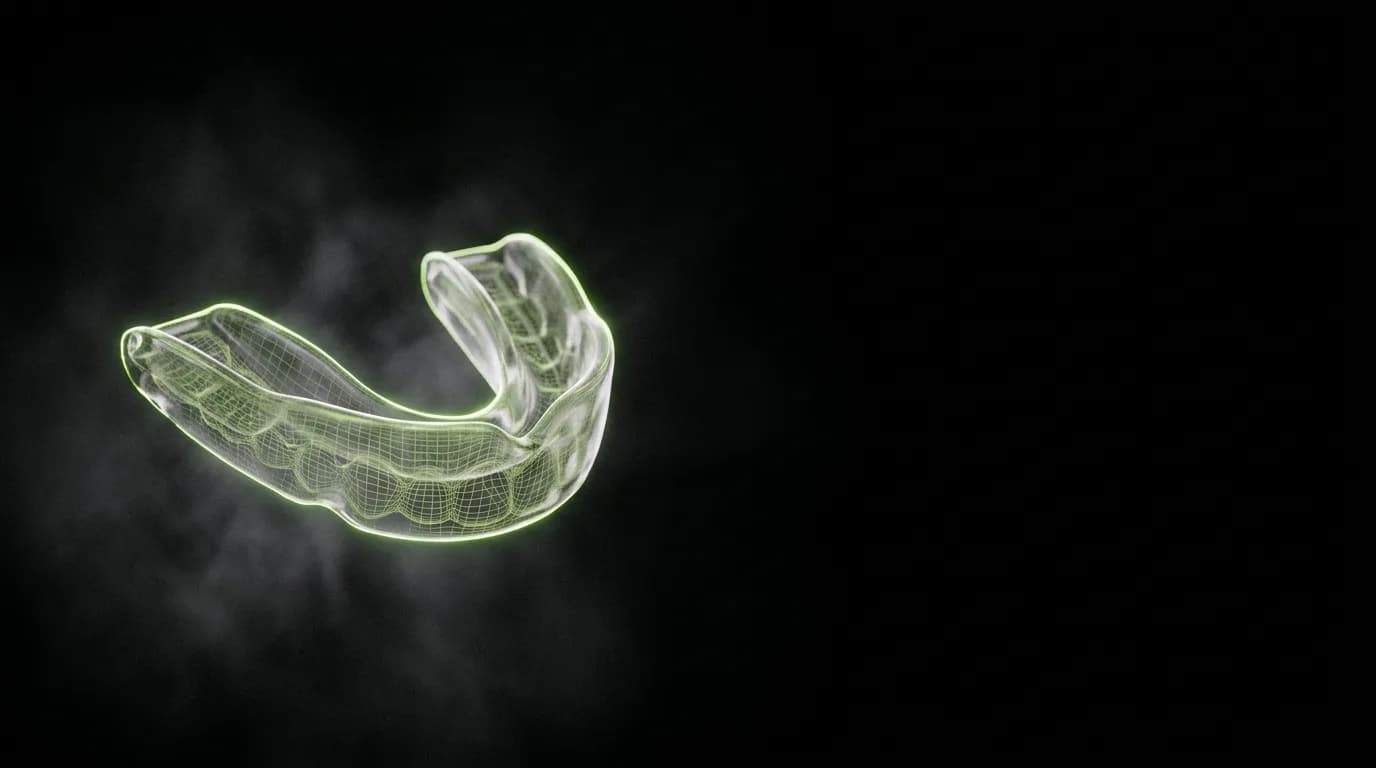
Combat sports punish a mouthguard differently than any other category. Direct-to-face strikes, ground exchanges, clinch grip, weight cuts, full rounds of mouth breathing — a guard built for contact sports will not survive any of it. This is the full breakdown of what a combat-rated guard has to do, sport by sport, and how to choose the right one before your next fight camp.
Why combat sports need different guards
Three things make combat-sport mouthguards a distinct category from contact-sport guards:
- Direct impact frequency. A rugby player might take one or two head shots a game. A boxer takes dozens of glancing strikes per round and several full-power ones. The material breaks down faster.
- Bite force during exertion. Combat athletes clench through 3–5 minute rounds. The guard has to absorb sustained biting pressure, not just impact moments.
- Breathing demand. When you are gassed in round three, you are mouth-breathing. A guard that obstructs airflow becomes a performance handicap — and that is where most boil-and-bites fail.
What a combat guard does, and does not do
A mouthguard has a narrow job, and it is worth being clear about it. It sits between your upper teeth and whatever lands on them, it spreads the force of a blow across the whole arch instead of letting one or two teeth take it, and it keeps your lips and cheeks from being cut against your own teeth. A well-fitted custom guard does those things well.
What it does not do is make you hit-proof. A guard reduces the risk of broken teeth and torn lips; it does not remove that risk, and GumGear makes no claim that any mouthguard prevents concussion. Head injuries are managed by sparring intensity, headgear where your rules require it, technique, and stopping when something is wrong. If you take a hard shot and feel dazed, nauseous or off afterwards, stop training and get checked by a doctor, whatever you had in your mouth.
MMA
MMA combines the strike profile of boxing, the takedown impact of wrestling, the clinch of Muay Thai, and the positional grappling of BJJ. A guard for MMA has to handle all of it. That generally means a custom-fit upper guard with combat-rated thickness, a clean anterior profile so it does not catch on a glove during a scramble, and breathing channels that work flat on your back as well as standing.
What makes MMA its own problem is that nothing separates the phases. A jab in the pocket turns into a knee in the clinch, which turns into a scramble on the mat, with no break in between. The guard takes a clean strike and then, a few seconds later, sustained compression while you are on the bottom or pinned against the cage. It has to survive both without moving.
Sport-specific gear choice, weight-cut considerations, and what coaches at top US camps look for in best mouthguard for MMA: what fighters actually need.
Boxing
Boxing focuses almost all force on a narrow strike profile — the jaw, the lips, the front incisors. Coaches want a guard that distributes force across the molars (where the jaw is structurally strongest) and protects the front teeth from the predictable straight punches and uppercuts of the sport.
What sets boxing apart is the lack of interruption. There is no clinch to wrestle through and no ground to go to: clean shots keep arriving straight at the jaw, round after round, with nothing to break up the contact. That repetition is what Combat Guard's extra layers are built for. It also changes how you should judge a guard. Do not ask how it felt on the first round of the heavy bag; ask whether it still sits exactly where you put it at the end of a hard sparring round, after hundreds of clenches.
Most sanctioned boxing bouts require a mouthguard, and custom-fit guards are widely used at amateur and professional level, but rules vary by organisation, so check yours. Some commissions specify colour or appearance rules, which a GumGear designer can accommodate at order time.
Muay Thai
Muay Thai and kickboxing add elbows and knees to the strike spectrum, which means impact angles can come from above (elbow down) and below (rising knee). The guard has to maintain coverage over the upper molars and full anterior because elbow strikes sometimes glance off the side of the jaw and then into the front teeth. Combat-rated thickness with multi-layer pressure-lamination is the standard.
The clinch is where Muay Thai separates from the other striking sports. A knee driven up into the chin and an elbow thrown at close range both land harder and sharper than a punch, and they land while your neck is being controlled and your head is being turned. A short, sharp strike on a head that cannot move away is the stress a Muay Thai guard has to be chosen for. In practice that means a snug, even grip on both sides of the arch, because a guard that holds well on the left and only marginally on the right is the one that shifts when a rising knee comes in off-line.
Kickboxing
Kickboxing opens the range up. You throw hands at boxing distance and kicks from further out, and you switch between them without warning, so the strike that arrives might come from a fist or a shin and you do not always see which. Combat Guard holds its seat either way. What to check is the rhythm side of things: the guard should not interfere with the quick in-and-out breathing between combinations, and it should stay put when you reset your stance, change direction and move your head.
Many kickboxers also cross-train in Muay Thai or MMA. One Combat Guard covers all of that, which is a simpler setup than juggling a different guard for each class.
BJJ and grappling
BJJ is technically a grappling sport, but it produces enough accidental dental contact that mouthguard rules for gi and no-gi competition vary by organisation and ruleset, so check yours. The strike profile is much lower than striking arts, so a Contact-tier guard is sufficient for most practitioners. Where BJJ does stress a guard is the clinch grip and headlock positions — the lateral force that pulls a poorly fitted boil-and-bite out of place.
The other BJJ-specific problem is communication. You need to be able to tell a partner to ease off, or tap and say so, without spitting the guard out first. A snug custom fit lets you speak clearly and breathe through your mouth under pressure, which a bulky or loose shell often does not. Accidental contact in BJJ tends to come from head clashes on guard passes, knees in scrambles and the odd elbow, all of which a Contact-tier guard handles.
BJJ is available on either tier, depending on preference — Contact Guard ($99) is the standard recommendation. Also training MMA? Step up to Combat Guard so one guard covers both.
Sport by sport at a glance
The table below puts the five sports side by side. The point is not that one is harder than another; it is that each one asks something different of the guard, and the answer to "which tier" follows from that.
| Sport | What lands, and how | What the guard is asked to do | Tier |
|---|---|---|---|
| MMA | Strikes, clinch and scramble with no pause between them | Stay seated through a strike, then sustained compression | Combat |
| Boxing | Clean, repeated shots straight to the jaw | Absorb direct impact round after round | Combat |
| Muay Thai | Knees and elbows at close range in the clinch | Hold even grip when the head cannot move away | Combat |
| Kickboxing | Fists and shins at changing range | Hold its seat whichever limb lands | Combat |
| BJJ | Grip, headlock pressure, accidental head and knee contact | Resist lateral load, keep you able to breathe and talk | Contact |
Contact Guard vs Combat Guard
GumGear's two-tier structure maps directly to this combat / contact distinction:
- Contact Guard — $99: rugby, hockey, lacrosse, BJJ, basketball, and recreational contact training. Lighter multi-layer build optimised for mobility and breathing on long shifts.
- Combat Guard — $169: MMA, boxing, Muay Thai, kickboxing — anything with sustained direct-strike exposure. Heavier multi-layer build, additional thickness over front incisors and molars.
Both are made by the same impression-based manufacturing process — full process here. The difference is in the lamination spec, not the fit method.
| Feature | Contact Guard | Combat Guard |
|---|---|---|
| Price | $99 | $169 |
| Front-tooth thickness | 4 mm | 6 mm |
| Typical lifespan | 6–12 months | 3–9 months |
| Built for | Rugby, hockey, lacrosse, BJJ, recreational contact | MMA, boxing, Muay Thai, kickboxing |
| Fit method | Your dental impression, pressure-laminated over a cast | Your dental impression, pressure-laminated over a cast |
Choosing your tier
If you are not sure which side of the line you fall on, work through these questions in order and stop at the first one that applies:
- Does anyone deliberately hit you in the face in training? Live sparring with contact to the head, even at moderate intensity, means Combat Guard.
- Do you compete in a striking sport? Combat Guard, plus a backup. See the fight-week section below.
- Do you train both grappling and striking? Combat Guard. It covers BJJ as well, so you only wear one guard to every class.
- Is your training grappling only? Contact Guard is the standard recommendation.
- Do you only hit pads and bags, with no live contact? Contact Guard is reasonable until you start sparring. When in doubt between the two, the one that matches your hardest session is the one to buy.
Cost is the other half of the decision, and it is less lopsided than the sticker price suggests once you factor in replacement cycles. The arithmetic is in is a custom mouthguard worth it.
Single-jaw vs double-jaw guards
Double-jaw guards (upper + lower bonded together) appear in catalogue listings claiming superior jaw stabilisation. In practice almost every working coach we have spoken to in the US prefers a single upper. The reasons are consistent: double guards restrict mouth opening, restrict breathing, and tend to come loose at the bond line during clinch exchanges. Unless your dentist has specifically recommended a double for a structural reason, single-jaw upper is the standard.
The fit check before you spar
Do not wait for a hard round to find out whether a guard fits. When a new guard arrives, run it through this sequence before you put it in front of a training partner. It takes about five minutes, and the underlying tests are explained in how to fit a mouthguard.
- Seat it and relax. It should stay on your upper teeth with your jaw loose. If you catch yourself clenching to hold it in, that is a retention problem.
- Push it with your tongue and thumb. It should not rock, pivot or lift on one side.
- Check the back edge. Run your tongue along both sides. You should feel material to the last molar, with no contact on your soft palate and no urge to gag.
- Shadowbox three hard minutes. Breathe through your mouth as you would late in a round. If you find yourself spitting it forward or adjusting it with your tongue, note which moment it happened.
- Talk. Say a few sentences, the way you would with your corner. Slurring badly or a heavy lisp suggests the guard is bulkier than it should be.
If it fails any of these, do not spar in it and hope it settles. A fit problem on a custom guard is covered by our 30-day fit guarantee, which includes a free remake, so contact us rather than living with it.
Breaking a new guard in
A custom guard fits closely, so it feels different from a loose boil-and-bite the first few times. Give your mouth a progression rather than debuting it in hard sparring:
- First sessions: pad work, bag work and drilling. Enough to get used to the feel of it and to breathe through it.
- Next: light technical sparring where contact is controlled and you can focus on whether it stays put.
- Then: normal sparring. By now you should have stopped noticing it.
Some awareness of a close-fitting guard is normal at the start. Sharp pressure on one tooth, or soreness along your jaw that does not ease, is not. If that happens, stop wearing it and read mouthguard jaw pain: causes and fixes. The point of the break-in is that your first bout is never the first time you have taken a real shot in that guard.
Common mistakes, and the fix
- Buying on thickness alone. A thick guard that shifts protects less than a thinner one that stays put. Fix: buy for retention first, then thickness for your sport.
- Hot water to "tighten" it. Re-softening a laminated guard to adjust it distorts the shape it was cast to. Fix: never use hot water on a custom guard; if the fit has changed, the answer is a fit check, not a kettle.
- Debuting a new guard on fight night. Fix: wear it through the break-in progression above, well before the bout.
- Storing it wet. A guard sealed in a closed case in a warm gym bag stays damp and starts to smell. Fix: air-dry it fully first, and keep it out of hot cars.
- Chewing on it between rounds. It wears the surface faster and the habit is hard on the guard. Fix: take it out, rinse it and put it back.
- Ignoring a guard that has started to shift. A fit that has changed is a guard that has stopped doing its job. Fix: check it against the tests above and replace it if it fails.
- Having one guard only. One guard means no backup when it cracks or goes missing the week of a fight. Fix: carry a second one.
Care under heavy training load
Combat athletes train 5–10 sessions per week. That cadence will destroy a guard faster than the listed lifespan if the care routine is wrong. The full daily/weekly/monthly routine is in mouthguard care, cleaning & replacement; the short version:
- Cool-water rinse after every session.
- Mild-soap soft-toothbrush clean once a week.
- Air-dry fully before storing. Never zip a wet guard into a closed case.
- Two guards in rotation if you train daily — one always drying.
- Track wear from month one. Replace at 3 months if you compete.
If yours has picked up a smell or a film, the cleaning steps and the products to avoid are in how to clean a mouthguard, and the wear signs that mean it is time to replace are in how long a mouthguard lasts.
Fight-week protocol
Bring two identical guards to a sanctioned fight: one for the bout, one as backup in case the corner cleans the first one with something it should not have been cleaned with. Order both at the same time so the impression matches and the fit is identical.
Plan to receive your fight-week guards at least two weeks before weigh-in. GumGear's 10–14 days turnaround means ordering at the very start of camp leaves margin for any impression reshoots and for the guard to be broken in during camp sparring. Leave the order until the week of weigh-in and you have no margin at all.
A simple camp rhythm: order and take your impression on day one (the at-home session itself is covered in how to take a dental impression at home); start the break-in as soon as the guards arrive; inspect both monthly; and in fight week, pack the bout guard and the backup together. Do not experiment with new cleaning products that week.
Rules differ between organisations and change over time, so confirm the current requirements with your coach or the event organiser before you finalise a design, especially if the event specifies guard type, colour or imagery.
If you wear braces
The at-home impression kit cannot make a braces-compatible guard. The putty has to release cleanly from what it is moulded around, and it does not release cleanly from orthodontic brackets without distorting. A guard for braces needs an in-person professional scan, not a home impression. If you train a combat sport in braces, get in touch with us before buying rather than ordering a standard kit.
When to see a dentist or doctor
- A tooth is knocked out, loosened, chipped or cracked. See a dentist straight away. Time matters, so do not wait to see whether it settles.
- Jaw pain, clicking, headaches or a change in how your teeth meet that persists after training. A dentist can tell you whether it is the guard, your bite or something else.
- Confusion, a headache that builds, nausea, vomiting or memory gaps after a hit. Stop training and get medical attention. A mouthguard does not rule out a head injury.
- A guard that is cracked, perforated or chewed through. Replace it. Do not tape or repair a guard you are relying on.