MMA punishes a mouthguard in ways no other sport does. The same round can include a head kick, a clinch, a takedown, a ground-and- pound exchange, and a guillotine attempt — and every one of those moments stresses the guard differently. Here is what the gear actually has to do, and what working coaches at top US camps look for in a fighter's mouthguard.
What MMA does to a mouthguard
Strikes, clinches, scrambles, and ground exchanges produce four distinct stress patterns:
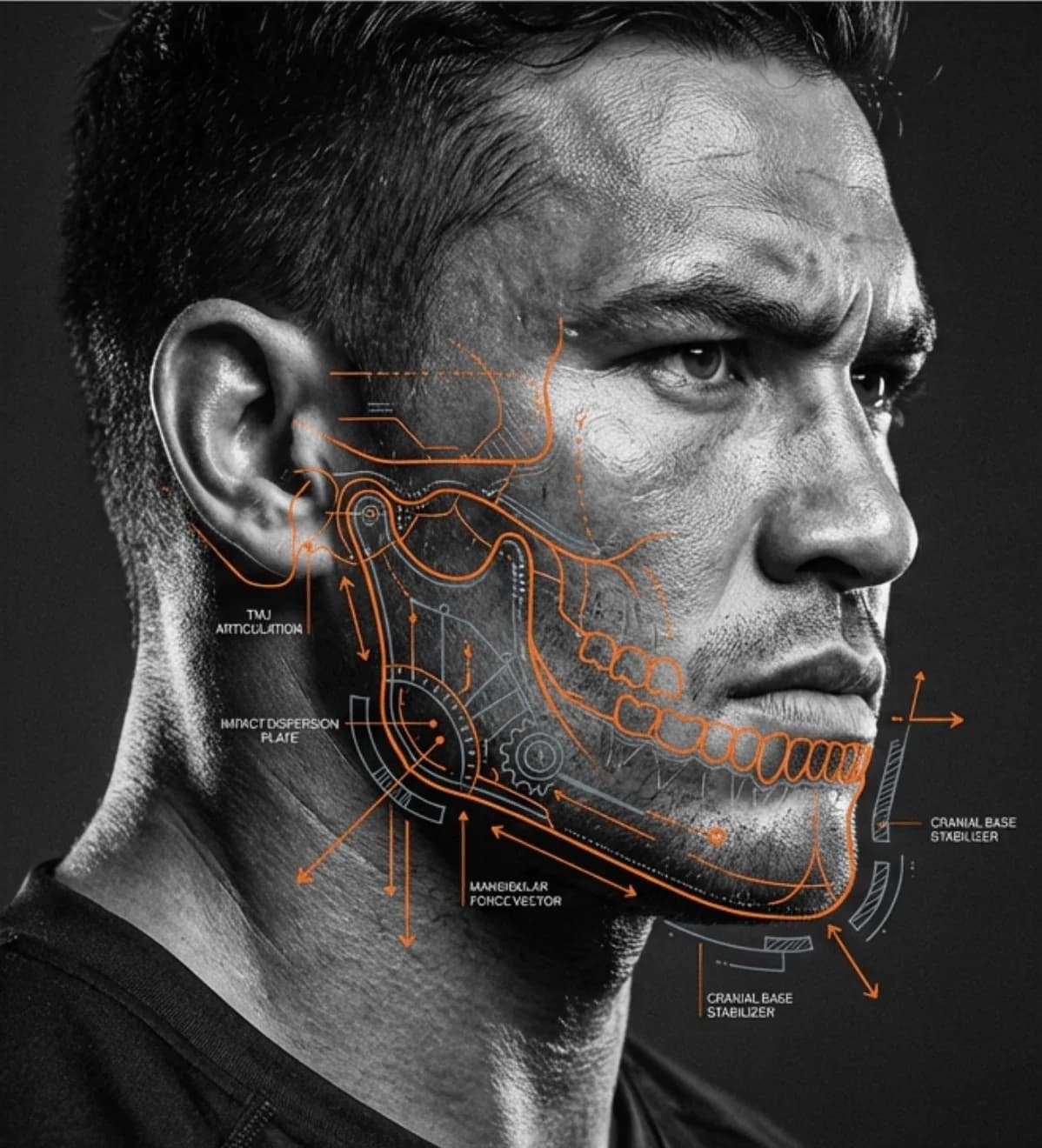
- Anterior strikes: straight punches and front kicks load force across the upper incisors. The guard has to spread the impact backwards along the dental arch into the molars.
- Lateral strikes: hooks, body kicks landing high, and elbow strikes load force from the side. The guard has to stay seated against rotational forces, not just compression.
- Clinch and pummel: repeated jaw clenching for control. The guard absorbs sustained bite force, not impact moments.
- Ground exchanges: face down against a forearm or a cage, the guard can shift if retention is poor — that is when fighters lose them mid-round and slip up later.
One exchange, four stresses
What makes MMA different from boxing or Muay Thai is that nothing separates the phases. A jab in the pocket turns into a knee in the clinch, which turns into a scramble on the mat, with no break in between. Here is what that does to a guard across a single ninety-second stretch of a round.
You trade at range, and a jab or a straight lands near the front teeth. The front of the guard takes the load and has to pass it back along the arch. You close and tie up against the cage, so now your jaw is clenched for control and an opponent's forearm or shoulder is pressing on your face. A knee comes up, you break away, and the exchange drops to the mat, where you are face down or pinned with your head turned and the force arriving from the side. Then you are back on your feet, throwing, breathing hard through your mouth.
That is four different stresses on one piece of EVA with no chance to adjust it between them. It is also why MMA is a retention problem before it is a thickness problem. A guard that handles the strike but slides forward during the clinch has failed at the next phase.
The non-negotiables
- Custom-fit only. Boil-and-bite is not an option at this level. See boil-and-bite vs custom for the protection mechanics.
- Multi-layer construction. Pressure-laminated medical-grade EVA in three or more layers. Single-layer EVA is not combat-rated regardless of thickness.
- Retention under lateral load. The guard has to stay seated when the jaw is twisted off-axis, not just when you clench straight down.
- Clear anterior profile. No edges that catch on gloves, mat surfaces, or your opponent's wrist during a scramble.
- Open breathing channels. A guard you cannot breathe through is a guard you will spit out by round two.
Single or double-jaw?
Double-jaw guards exist and are marketed for combat sports. In practice almost every working coach we have spoken to prefers a single upper. Double guards restrict mouth opening — which matters when you have to communicate with your corner and breathe through your mouth in late rounds — and they tend to come apart at the bond line during clinch exchanges. Single-jaw upper is the default. If you have a structural reason for a double (TMJ issues, prior jaw fracture), your dentist will tell you.
Weight cuts and fit changes
A weight cut does not normally change how a mouthguard fits, because your teeth do not change shape, but a very hard cut can change how it feels. Take your impression well ahead of the bout, at a normal training weight, so there is time to break the guard in and fix any fit problem before fight week.
What you notice in cut week is usually about your mouth rather than the guard. Saliva thins, a dry mouth changes how a guard grips, and a perfectly good guard can feel different. Do not trim it, re-soften it or try to reshape it to compensate. Rinse it in cool water, seat it as you normally would, and if it still does not sit right, switch to your backup and get in touch with us. How you manage the cut itself is a matter for your coach and your doctor, not your mouthguard.
Breathing in round three
Anaerobic capacity in late rounds is partly determined by how much air you can move through your mouth. A guard with raised ridges across the biting surface and proper breathing channels moves significantly more air than a flat-surfaced boil-and-bite. Fighters routinely report a perceived cardio improvement after switching to custom — the cardio did not change, the airflow did.
You can test this directly. Hold a hard 30 seconds on the pads or the bag, then take a few breaths through your mouth with the guard in. If you feel you are pulling air against the guard, or you find yourself pushing it forward with your tongue to breathe, the fit or profile is working against you. Late-round breathing is also the moment a poorly seated guard starts to drift, which is why the two problems often show up together.
Testing a guard the way MMA tests it
A static fit check is a start, and the general version is in how to fit a mouthguard. MMA needs a few extra tests, because the guard has to hold in positions most sports never put you in. Do these in training, with a willing partner and controlled pressure, before the guard goes anywhere near a hard session.
- On your back. Lie flat and breathe normally. The guard should not shift toward your throat or slide forward onto your lips.
- Under the forearm. Have a partner press a forearm lightly across your jaw and cheek, the way a cage wall or a pinned position would. It should not rotate or lift.
- Two minutes of clinch work. Pummel and tie up, jaw clenched as it would be. Check afterwards for movement with your tongue, not just by feel.
- Pad rounds. Breathe hard through your mouth and see whether you are fighting the guard for air.
- Talk to your corner. You should be able to speak clearly enough for them to understand you between rounds.
If it fails, do not wait to see whether it settles. Contact us, because a fit problem is covered by our 30-day fit guarantee, which includes a free remake.
Which sessions need the guard
The obvious answer is sparring and competition, and that is right, but MMA training has more contact moments than the label suggests. Wear it for live striking and for clinch work. Wear it for wrestling and BJJ rolling inside MMA class too: head clashes on takedown entries and guard passes are exactly the accidental contact that costs people teeth. You can skip it for solo bag work and pure technical drilling with no contact to the head, although many fighters wear it anyway so the habit and the feel never change.
One note on rotation: if you split your week between a striking-heavy and a grappling-heavy class, resist the temptation to keep a different guard for each. One Combat Guard covers both, and you spend less time deciding what to pack.
Amateur vs professional inspection
Some amateur MMA events and athletic commissions inspect mouthguards before a bout, and the rules differ. Common requirements are no sharp-edged design elements, a colour that is not easily mistaken for blood, and a guard in good condition (no perforation, no chunks missing). Confirm the specifics with the organiser.
Some pro commissions add: no graphic imagery (skulls, weapons, explicit text) for televised bouts. The GumGear customiser lets you render a fight-week version of your design — keep the unrestricted version for training and order a clean one for the cage. Same impression file; new design at order time.
Rules differ by promotion and by state, and they change, so confirm the current requirements with your coach or the event organiser before you finalise a design, especially if the event specifies guard type, colour or imagery.
Combat Guard, every time
For MMA, the answer is GumGear Combat Guard ($169). Contact Guard ($99) is the right tier for BJJ-only practitioners and contact-sport athletes, but the strike component of MMA needs the heavier multi-layer build of Combat Guard. The price difference between tiers is the layer count and the additional thickness over your incisors and molars — that is exactly the spec MMA needs.
| Feature | Contact Guard | Combat Guard |
|---|---|---|
| Price | $99 | $169 |
| Front-tooth thickness | 4 mm | 6 mm |
| Typical lifespan | 6–12 months | 3–9 months |
| Right for | BJJ-only and contact-sport athletes | Anyone in MMA who strikes in training |
The lifespan difference is not a flaw. A guard that takes direct strikes wears through its outer layers sooner, so budget for a replacement or two a year if you are in camp often. How to read the wear signs is in how long a mouthguard lasts.
Mistakes MMA athletes make
- Swapping guards between classes. Wearing a custom guard for sparring and a spare boil-and-bite for grappling means one of your classes is unprotected. Fix: one Combat Guard for everything.
- Skipping it for wrestling and rolling. Head clashes on takedown entries and guard passes are accidental, which is why they catch people out. Fix: wear it for any live session.
- Putting it down on the mat or in a glove. The floor is the dirtiest place in the gym. Fix: into the case, every time, then rinse it afterwards.
- Leaving cleaning to the corner. A well-meaning cornerman with a bottle of something harsh will damage it. Fix: brief them. Cool water only.
- Designing for looks and forgetting the rules. A design that fails inspection is a design you did not need. Fix: build a clean fight-week version.
- Debuting it on fight night. The first time you take a real shot in the guard should be in sparring, not the bout. Fix: break it in during camp, as in the plan below.
Fight-camp procurement plan
- Week 0 (camp starts): order two Combat Guards from the same design. Same impression, two guards, identical fit. Use one for training, keep one sealed for fight night.
- Week 2: guards arrive (10–14 days from order). Wear the training guard for every session from this point on so you are adapted to it.
- Weeks 2–7: training. Inspect the guard monthly. Replace if you see perforation or fit loss.
- Week 8 (fight week): swap to the fresh guard. Pack both. Bring the training guard as backup.
Care under camp load matters more than usual — daily rinse, weekly deep clean, two guards in rotation. Full routine in mouthguard care, cleaning & replacement. For the broader combat-sport context, see mouthguards for combat sports. If you are ordering your first custom guard, the at-home impression session is covered in how to take a dental impression at home.
Fight night and the corner
Fight night is logistics, and guards go wrong in the gaps. Pack the bout guard and the backup together in a ventilated case, not loose in a bag pocket. Rinse the bout guard in cool water when you arrive and let it air-dry rather than sealing it up damp. Tell your cornerman where each guard is and what to do with it: between rounds it gets a cool-water rinse, nothing stronger, and it goes back in the case, not into a pocket or onto the floor.
Do not try new cleaning products, a new design or a new guard in fight week. The fit you trained in is the one you want in the cage. And if the guard cracks, feels loose or goes missing before the bout, swap to the backup without second-guessing it. That is what the second one is for.
If you wear braces
The at-home impression kit cannot make a braces-compatible guard, because the putty will not release cleanly from around orthodontic brackets. A guard for braces needs an in-person professional scan. If you fight in braces, get in touch with us before buying rather than ordering a standard kit.
When to see a dentist or doctor
- A tooth is knocked out, loosened, chipped or cracked. See a dentist straight away; time matters.
- Persistent jaw pain, clicking, headaches or a change in how your teeth meet after training or a fight. A dentist can say whether it is the guard, your bite or something else. Our guide to mouthguard jaw pain covers the common causes.
- Confusion, a worsening headache, nausea, vomiting or memory gaps after a hit. Stop and get medical attention. A mouthguard reduces the risk of dental injury; it does not rule out a head injury, and GumGear makes no claim that it prevents concussion.
- A cracked, perforated or chewed-through guard. Replace it rather than repairing it.