Jaw pain that shows up during or after wearing a mouthguard is common enough to be worth taking seriously, and specific enough to usually have a mechanical explanation. An ill-fitting boil-and-bite is one of the more frequent contributors, because a generic shell can quietly force your jaw into positions it would not otherwise hold. This is not a diagnosis article — it is a guide to the mechanical side of the problem, how to tell whether a refit might help, and when the right move is to stop reading this and talk to a dentist instead.
The short answer
A mouthguard that does not seat correctly can ask your jaw muscles to do work they should not have to do — holding a bite position, compensating for uneven material, or clenching just to keep the guard from slipping. Over a training session or a season, that extra muscular load can present as soreness, fatigue, or aching around the jaw joint. Swapping to a guard that actually fits removes that specific mechanical contributor. It does not treat an underlying joint or muscle condition, and it is not a substitute for a dentist when the pain looks like more than a fit problem. The next section covers exactly where that line sits.
When to see a dentist first
Before anything about guards and fit: some patterns point away from a mouthguard entirely and toward a dentist or doctor, and they deserve a direct answer instead of a workaround.
If none of that applies — the discomfort is mild, shows up mainly during or right after wearing the guard, and settles down once the guard comes out — the mechanical causes below are worth working through. If you are ever unsure which category you are in, treat it as the first one and get it looked at. That call costs you a conversation; guessing wrong costs you more.
How a guard can contribute to jaw pain
A mouthguard sits directly in the path of every bite force your jaw generates, so small errors in its shape get transmitted straight into the muscles and joint that move your jaw. A guard does not need to be dramatically wrong to matter here — a few millimetres of uneven material, or a bite surface that is slightly higher on one side, is enough to change how your jaw wants to sit while you wear it. Three specific failure patterns in a home-fitted boil-and-bite show up often enough to be worth naming individually.
An uneven bite forces your jaw to hold a position
When a boil-and-bite is pressed into shape by hand, it is common for one side to pick up a thicker or higher impression than the other — a harder bite on the left, a shallower press on the right. Once that shell cools and sets, your back teeth no longer meet it at the same level on both sides. To keep the guard seated and your jaw comfortable, your jaw muscles end up holding a slightly shifted position rather than resting in a neutral one. Muscles that hold a static, asymmetric position for an entire training session or sparring round can ache afterward in a way that has nothing to do with any single impact — it is sustained, uneven muscular effort, and the jaw joint and surrounding muscles are exactly where that kind of strain tends to surface.
Uneven thickness and a bulky rear
The second common pattern is a guard that ends up thicker toward the back of the mouth than a hand-moulded shell was ever meant to be, because trimming and pressing a warm shell evenly all the way to the last molar is hard to do consistently. A guard that is noticeably bulkier over the rear molars changes how your back teeth come together compared to the front, which again nudges your jaw away from its natural resting path. Over repeated bites and clenches during play, that posterior bulk is a second, independent way the same jaw ends up doing extra, lopsided work.
Clenching just to keep it in place
The third pattern compounds the first two. If a guard does not grip the undercuts of your teeth well enough to stay seated on its own, the only way to keep it from slipping during play is to clench down on it — consciously or not — for the entire time it is in your mouth. Clenching is sustained, high-effort muscle activity, and doing it continuously for a full training session or match is a meaningfully different load on your jaw than biting down briefly during normal use. A guard that needs to be clenched to stay put is asking your jaw to do a second job it was never built around, on top of whatever bite imbalance or uneven thickness it already has to compensate for.
Refit signal vs. outside our scope
It helps to separate two different questions, because they call for two different responses. The first question is: does this guard fit correctly? The second is: is something else going on with my jaw, independent of the guard? A mouthguard company can speak to the first question. It cannot answer the second, and should not try to.
Signs that point toward a fit problem worth addressing with a refit: the ache only shows up while the guard is in, or in the hour or so afterward; it is roughly symmetrical in how it feels, or tracks with a side of the guard you already suspect is uneven; it improves noticeably on days you skip wearing that particular guard; and it has not been getting worse over time. For the exact checks a correctly seated guard needs to pass — retention without clenching, full coverage to the last molar, no gagging, no rocking under pressure — see how to fit a mouthguard. If your guard fails one or more of those checks, a fit problem is a reasonable working explanation and a refit is a reasonable next step.
Signs that point outside a mouthguard company's scope: pain that persists even on days you are not wearing the guard at all; pain that is spreading, worsening, or changing character over time; anything involving clicking, locking, swelling, numbness, or night waking as covered above; and pain that started with or after an impact rather than building up gradually from wear. Those patterns suggest something structural or clinical that a refit cannot touch, and they are exactly what a dentist is positioned to actually evaluate. We are not going to pretend a better guard solves a problem that was never caused by the guard in the first place.
What a cast-based fit changes structurally
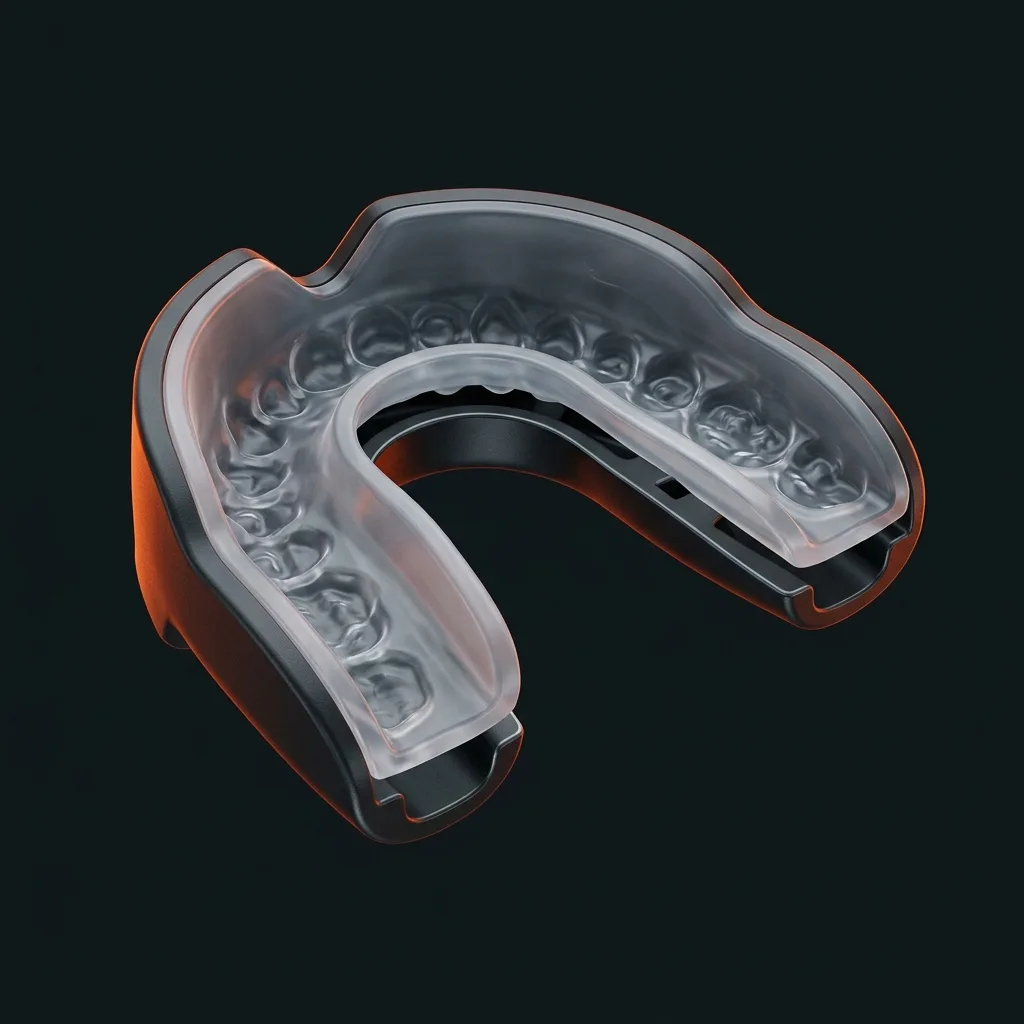
A custom guard made from a cast of your dental impression addresses the three mechanical patterns above by removing the step where they get introduced, rather than by correcting for them afterward. GumGear takes your impression, produces a positive cast of your exact arch, and pressure-laminates multiple layers of medical-grade EVA over that cast. The bite surface is built from the geometry of your own teeth on both sides at once, instead of being pressed into shape by hand against whichever side happened to bite down harder in the moment.
That ordering changes each of the three patterns directly. Both sides of the bite surface come from the same cast, so there is no structural reason for one side to sit higher than the other. Thickness is controlled across the whole arch during lamination, including the rear molars, rather than depending on how evenly someone managed to press a warm shell back that far. And retention comes from the cast capturing the real undercuts of your teeth, so the guard stays seated without clenching to hold it there. None of that depends on technique or a better second attempt at home — it is a property of how the guard is made, not how carefully it is used.
To be precise about what this claim is and is not: a correctly fitted guard removes a possible mechanical contributor to jaw discomfort. It is not a treatment for a joint or muscle condition, and it does not diagnose or cure anything. If your pain turns out to be caused by something other than fit, a better guard will not resolve it — which is exactly why the routing above matters more than the fit advice does.
What to do next
If the pain pattern matches the dentist-first list, stop there and make that appointment before doing anything else. If it looks more like a fit issue, the safe, limited self-help step is straightforward: stop wearing the ill-fitting guard, run it through the four fit checks in how to fit a mouthguard, and if it fails any of them, get it refitted rather than continuing to train in a guard that is asking your jaw to compensate for it. A cast-based custom guard — covered in full in the complete custom mouthguard guide — is one way to remove the bite-imbalance, thickness, and retention issues at the source rather than managing them session by session. Refits for a guard that is not fitting as expected are covered under our standard support — reach out and we will sort it rather than have you keep training through it.
If you're in braces
Braces themselves can cause jaw discomfort of their own — pressure from adjustments, bite changes as teeth move, wires or brackets irritating soft tissue. That is a matter for your orthodontist or dentist, not something a mouthguard fit can address. Separately, an at-home impression kit cannot produce a braces-compatible mouthguard fit — the putty needs to release cleanly from whatever it is moulded around, and it will not do that over brackets and wires without tearing or distorting. A braces-compatible fit needs an in-person professional dental scan, which is not something we offer today. If you are in braces and dealing with jaw pain, start with your orthodontist rather than troubleshooting a guard fit.